Previously, we used `useLiveData(guardService.can$())` to get the guard result, but `guardService.can$()` will request the server to revalidate the permission when calling it, will cause additional network requests when re-render.

This pr make a new hook `useGuard` to fix this problem.

And the side effect in `can$` is moved to `revalidateCan()` to make that the subscribe method is pure
Close [BS-2834](https://linear.app/affine-design/issue/BS-2834).

### What Changed?
- Add `addContextCategoryMutation` and `removeContextCategoryMutation` graphql apis.
- Provide tag and collection apis for front-end components.
AudioMedia entity for loading & controlling a single audio media
AudioMediaManagerService: Global audio state synchronization across tabs
AudioAttachmentService + AudioAttachmentBlock for manipulating AttachmentBlock in affine - e.g., filling transcription (using mock endpoint for now)
Added AudioBlock + AudioPlayer for rendering audio block in affine (new transcription block whose renderer is provided in affine)

fix AF-2292
fix AF-2337
Currently, `GfxViewportElement` hides DOM blocks outside the viewport using `display: none` to optimize performance. However, this approach presents two issues:
1. Even when hidden, all top-level blocks still undergo frequent CSS transform updates during viewport panning and zooming.
2. Hidden blocks cannot access DOM layout information, preventing `TurboRenderer` from updating the complete canvas bitmap.
To address this, this PR introduces a refactoring that divides all top-level edgeless blocks into two states: `idle` and `active`. The improvements are as follows:
1. Blocks outside the viewport are set to the `idle` state, meaning they no longer update their DOM during viewport panning or zooming. Only `active` blocks within the viewport are updated frame by frame.
2. For `idle` blocks, the hiding method switches from `display: none` to `visibility: hidden`, ensuring their layout information remains accessible to `TurboRenderer`.
[Screen Recording 2025-03-07 at 3.23.56 PM.mov <span class="graphite__hidden">(uploaded via Graphite)</span> <img class="graphite__hidden" src="https://app.graphite.dev/api/v1/graphite/video/thumbnail/lEGcysB4lFTEbCwZ8jMv/4bac640b-f5b6-4b0b-904d-5899f96cf375.mov" />](https://app.graphite.dev/media/video/lEGcysB4lFTEbCwZ8jMv/4bac640b-f5b6-4b0b-904d-5899f96cf375.mov)
While this minimizes DOM updates, it introduces a trade-off: `idle` blocks retain an outdated layout state. Since their positions are updated using a lazy update strategy, their layout state remains frozen at the moment they were last moved out of the viewport:
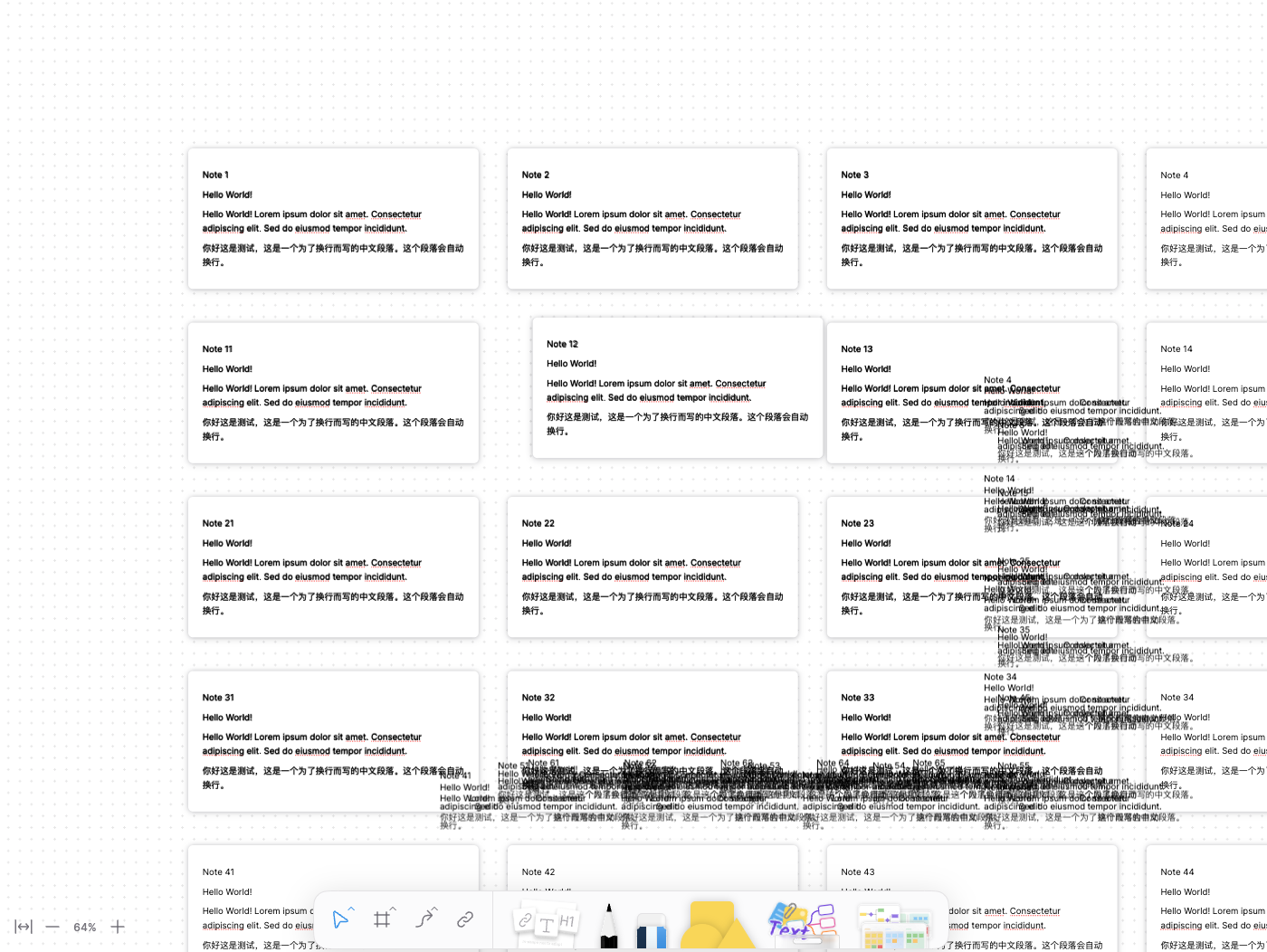
To resolve this, the PR serializes and stores the viewport field of the block at that moment on the `idle` block itself. This allows the correct layout, positioned in the model coordinate system, to be restored from the stored data.
 EYHN
EYHN