### Overview:
We've been working with some legacy code in the default-tool and edgeless-selected-rect modules, which are responsible for fundamental operations like moving, resizing, and rotating elements. Currently, these operations are hardcoded, making it challenging to extend functionalities without diving deep into the code.

### What's Changing:
Introducing `ElementTransformManager` to streamline the handling of basic transformations (move, resize, rotate) while allowing the business logic to dictate when these actions occur.

Providing two ways to extend the transformations behaviour:
- Extends inside element view definition: Elements can decide how to handle move/resize events, such as enforcing size constraints.
- Extension mechanism provided by this manager: Adjust or completely override default drag behaviors, like snapping elements into alignment.

### Code Examples:
Delegate element movement to TransformManager:
```typescript
class DefaultTool {
  override dragStart(event) {
    if(this.dragType === DragType.ContentMoving) {
      const transformManager = this.std.get(TransformManagerIdentifier);
      transformManager.startDrag({ selectedElements, event });
    }
  }
}
```

 Enforce minimum width inside view definition:
```typescript
class EdgelessNoteBlock extends GfxBlockComponent {
  onResizeDelta({ dw, dh }) {
    const bound = this.model.elementBound;
    bound.w = Math.min(MAX_WIDTH, bound.w + dw);
    bound.h = Math.min(MAX_HEIGHT, bound.h + dh);
    this.model.xywh = bound.serialize();
  }
}
```

Use extension to implement element snapping:
```typescript
import { TransformerExtension } from '@blocksuite/std/gfx';

// Just extends the TransformerExtension
class SnapManager extends TransformerExtension {
  static override key = 'snap-manager';
  onDragInitialize() {
    return {
      onDragMove(context) {
        const { dx, dy } = this.getAlignmentMoveDistance(context.elements);
        context.dx = dx;
        context.dy = dy;
      }
    }
  }
}
```

### Others

The migration will be divided into several PRs. This PR mostly focus on refactoring elements movement part of `default-tool`.
- Delegate elements movement to `TransformManager`
- Rewrite the default tool extension into `TransformManager` extension
- Add drag handler interface to gfx view (both `GfxBlockComponent` and `GfxElementModelView`) to allow element to define how it gonna react on drag
Currently, `GfxViewportElement` hides DOM blocks outside the viewport using `display: none` to optimize performance. However, this approach presents two issues:
1. Even when hidden, all top-level blocks still undergo frequent CSS transform updates during viewport panning and zooming.
2. Hidden blocks cannot access DOM layout information, preventing `TurboRenderer` from updating the complete canvas bitmap.
To address this, this PR introduces a refactoring that divides all top-level edgeless blocks into two states: `idle` and `active`. The improvements are as follows:
1. Blocks outside the viewport are set to the `idle` state, meaning they no longer update their DOM during viewport panning or zooming. Only `active` blocks within the viewport are updated frame by frame.
2. For `idle` blocks, the hiding method switches from `display: none` to `visibility: hidden`, ensuring their layout information remains accessible to `TurboRenderer`.
[Screen Recording 2025-03-07 at 3.23.56 PM.mov <span class="graphite__hidden">(uploaded via Graphite)</span> <img class="graphite__hidden" src="https://app.graphite.dev/api/v1/graphite/video/thumbnail/lEGcysB4lFTEbCwZ8jMv/4bac640b-f5b6-4b0b-904d-5899f96cf375.mov" />](https://app.graphite.dev/media/video/lEGcysB4lFTEbCwZ8jMv/4bac640b-f5b6-4b0b-904d-5899f96cf375.mov)
While this minimizes DOM updates, it introduces a trade-off: `idle` blocks retain an outdated layout state. Since their positions are updated using a lazy update strategy, their layout state remains frozen at the moment they were last moved out of the viewport:
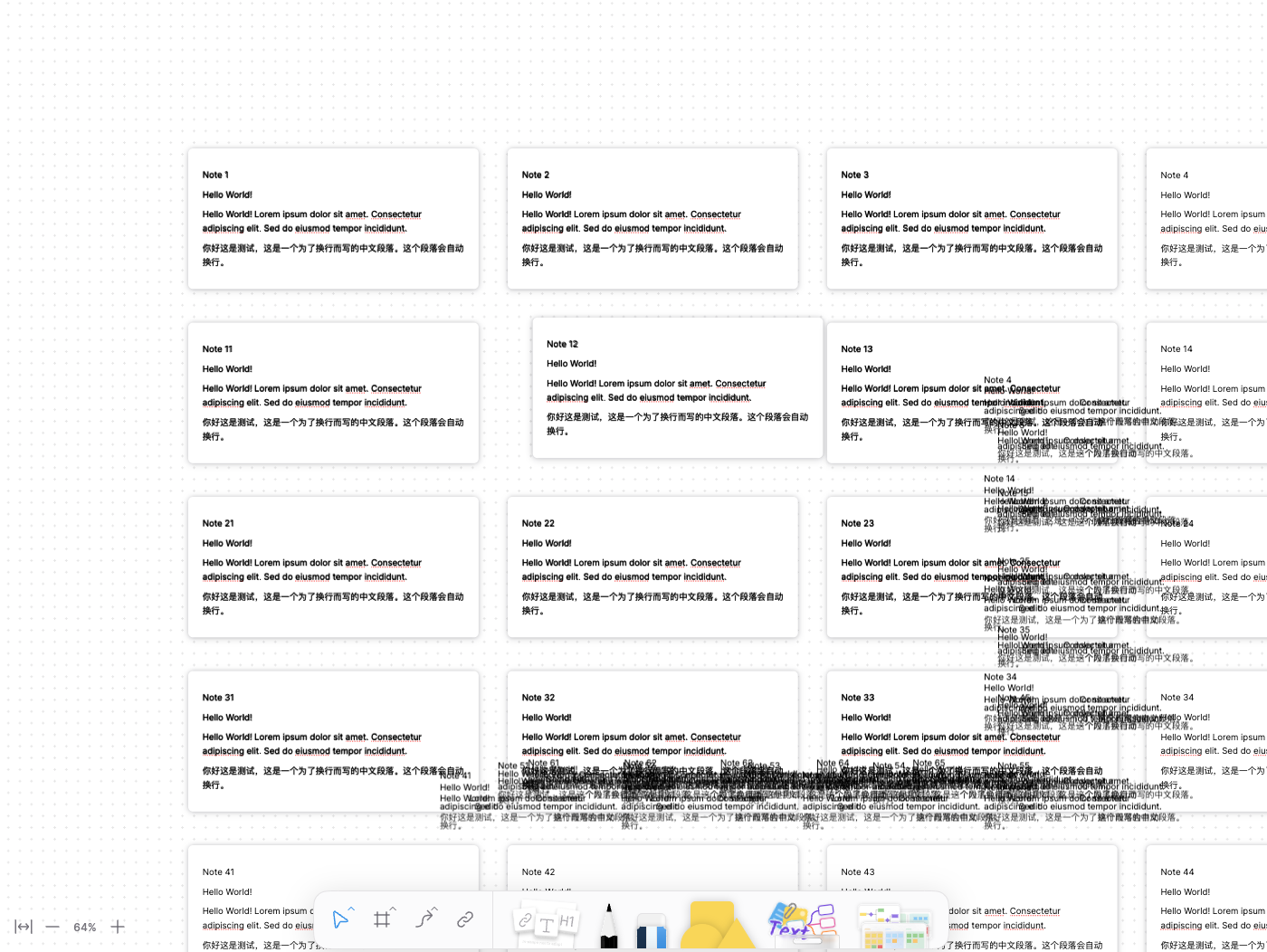
To resolve this, the PR serializes and stores the viewport field of the block at that moment on the `idle` block itself. This allows the correct layout, positioned in the model coordinate system, to be restored from the stored data.